Reading time: 2 minutes
Here’s a question nobody wants to think about: if you died tomorrow and your spouse later remarried, could your children end up with nothing?
For a lot of families, the answer is yes. And they don’t even know it.
It’s called sideways disinheritance — and it’s one of the most common estate planning mistakes in the UK. Think of it like passing a family heirloom to a friend for safekeeping, only for them to hand it on to someone you’ve never met.
How it happens — a scenario:
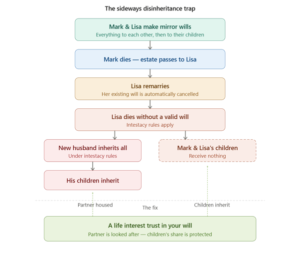
Mark and Lisa have been married for 20 years. They have two children. They made mirror wills years ago, leaving everything to each other and then to the kids.
Mark dies. Everything passes to Lisa — exactly as planned.
A few years later, Lisa meets someone new and remarries. The moment she marries, her existing will is automatically cancelled under current law in England and Wales. She means to make a new one but never gets around to it.
Lisa dies without a valid will.
Under the intestacy rules, her entire estate — including the family home that she and Mark built together — passes to her new husband. When he eventually dies, it passes to his children from a previous relationship.
Mark and Lisa’s children receive nothing.
Not a penny of the home they grew up in. Not a share of the savings their parents built together. Nothing.
This isn’t a rare edge case
Blended families now make up an estimated one in three UK families. Divorce and remarriage later in life are increasingly common. And according to estate planning data, 60% of widowed men and 20% of widowed women are likely to remarry/re-partner.
Meanwhile, specialist solicitors estimate around 10,000 will disputes are filed every year in England and Wales — and sideways disinheritance is a significant driver.
The Financial Times reported a 37% increase in family will disputes over a two-year period. When sideways disinheritance triggers a court battle, the legal fees can eat through the very estate the family is fighting over.
Why mirror wills don’t protect you?
Most couples assume that mirror wills — where you each leave everything to the other and then to the children — are watertight. Not always.
The problem is simple: once one of you dies, the survivor owns everything outright and can do whatever they want with it. They can change their will. They can remarry (which cancels it). They can give it away. There’s nothing binding about a mirror will after the first death.
It’s a bit like writing a recipe on a whiteboard and trusting nobody will wipe it clean. The intention is clear, but there’s no lock on it.
The fix: a life interest trust
A life interest trust in your will solves this cleanly. Here’s how it works:
When you die, your share of the family home (and other specified assets) doesn’t pass outright to your spouse. Instead, it’s placed into a trust.
Your spouse becomes the “life tenant” — they can live in the home, benefit from the assets, and carry on with their life. But they don’t own your share outright. They can’t sell it, give it away, or let it pass to a new spouse.
When they die (or if they remarry or move into care, depending on how you set it up), your share passes directly to your children — as you originally intended.
Your spouse is looked after. Your children are protected. Nobody falls through the gap.
Who needs to think about this?
You should consider a life interest trust if any of these apply:
- You are in a second marriage or relationship
- You or your spouse have children from a previous relationship
- You have a blended family
- Your spouse is significantly younger or older than you
- You want to protect your children’s inheritance while still providing for your spouse
Even if you’re in a first marriage with no plans to separate, life is unpredictable. A trust doesn’t assume the worst — it simply makes sure your wishes hold, whatever happens.
Have a conversation about it. If you’re in a blended family, or even if you’re just wondering whether your current wills are doing what you think they’re doing, it’s worth having a chat.
This article is for general information only and does not constitute legal, tax, or financial advice. Laws and tax rules can change. For advice on your personal circumstances, please consult a qualified legal or financial professional.
Sources:
- ONS (2021): Approximately 781,000 stepfamilies in the UK; blended families estimated at one in three UK families
- Stellar Asset Management: Specialist solicitors estimate approximately 10,000 will disputes filed annually in England and Wales
- Wills Act 1837, s.18: Marriage revokes existing will unless made in contemplation of that marriage