2-minute read
You wouldn’t drive your car for ten years without an MOT. But most people do exactly that with their Will.
Life moves. Families change. The law changes too — and right now, more than at any point in nearly 200 years, the rules around wills, pensions, and inheritance tax in the UK are shifting.
Why “set and forget” is the most dangerous approach
Recent research suggests only around 37% of UK adults have a valid will, and of those who do, a significant proportion haven’t updated it in years. Some of those wills no longer reflect the family they were written for. Others reference people who have died, addresses that no longer exist, or assets that have been sold.
A will that’s out of date can cause as much pain and confusion as no will at all — sometimes more, because it gives families false confidence that everything is “sorted.”
MOT Mindset
Here’s the simple rule: review your will every year, and immediately whenever one of these seven life events happen.
The 7 life events that should trigger an immediate review
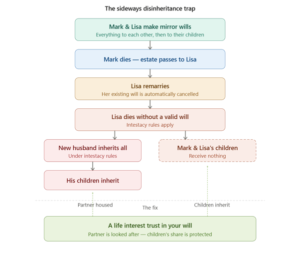
1. You get married or enter a civil partnership. Under current UK law, getting married automatically cancels your existing will. The day after your wedding, unless you make a new one, you’re effectively intestate.
Action: If you’re getting married, make a new will after the wedding — or make one before that’s specifically expressed to be “in contemplation of marriage.”
2. You separate or divorce. Divorce doesn’t cancel your will — it just quietly breaks parts of it. Separation changes nothing legally, which is the bigger risk. If you die while separated but not divorced, your estranged spouse may still inherit substantially under the terms of your existing will or intestacy.
Action: Review immediately on separation, and again when the divorce is finalised.
3. A new baby or grandchild arrives. Who’s the guardian? At what age do they inherit? Should it be held in trust until they’re older? These questions need answering now, not later.
Action: Review on the birth of every child, and again when grandchildren arrive if you want to provide for them directly.
4. You buy, sell, or inherit property. Check how it’s owned — joint tenants pass automatically to the survivor, tenants in common don’t. The wrong setup can undo your whole plan.
Action: Review whenever you move, remortgage, or inherit property.
5. Someone named in your will dies, or your key relationships change. If your executor, guardian, or main beneficiary dies before you, your will may still be technically valid but practically broken. The same applies if someone named in your will is no longer someone you want to benefit — an estranged child, a former friend, an ex-partner.
Action: Review whenever there is a death in your circle, or whenever a key relationship changes significantly.
6. Your finances change significantly. Business sale, inheritance, pension growth, buy-to-let, redundancy, etc. Anything that meaningfully shifts your wealth shifts your plan. Each of these can change your inheritance tax position, your liquidity, and the fairness of how your estate is divided.
Action: Review after any change that meaningfully shifts your overall wealth.
7. The law changes (and right now, it really is). This is the one most people miss. Even if your life hasn’t changed at all, the legal landscape around your estate may have moved. From 6 April 2027, most unused pension pots will count towards your estate for inheritance tax. And the Law Commission’s 2025 Modernising Wills Law report has recommended the biggest shake-up since 1837.
Action: Review your will and pension nominations now, and again once the 2027 changes take effect.
Don’t forget your LPAs
A will takes effect when you die. A Lasting Power of Attorney protects you while you’re still alive but unable to make decisions. Without one, your family can’t simply step in — they face the Court of Protection, which is slow, stressful, and expensive.
A will protects your family for the day you die. An LPA protects them every day before that.
Your simple Estate Planning MOT checklist
Print this. Pin it to the fridge. Run through it once a year, and every time one of the seven life events happens.
[ ] My will exists and I know where it is
[ ] My will is less than 5 years old, OR has been reviewed in the last 12 months
[ ] My executors are still alive, capable, and willing
[ ] My beneficiaries are correct and up to date
[ ] My guardianship choices (if I have children under 18) still reflect my wishes
[ ] My property ownership (joint tenants vs tenants in common) matches my plan
[ ] I have reviewed my pension nominations in light of the April 2027 IHT changes
[ ] I have a Property and Financial Affairs LPA registered
[ ] I have a Health and Welfare LPA registered
[ ] My family knows where these documents are kept
If you ticked fewer than seven of those, your estate plan needs a service.
Not sure where to start? Get in touch with The Right Will for a friendly, no-pressure chat.
This article is for general information only and does not constitute legal or financial advice.
Sources: GOV.UK — IHT on unused pension funds · Law Commission — Modernising Wills Law